Rearing Monarchs #19:
Dominion and Creativity, part 3
Unification Thoughts, November 2022
Welcome back
In case you’re joining us for the first time, it’d be best to take a
look at the purpose and focus of this Rearing
Monarchs series, of which this article is the 18th.1
Where we left off and where we’re going
Last time, we’d explored the idea that creativity is driven by two purposes, and that it’s critical to understand the nature of the two and how they complement each other. With this understanding, we are able to guide the creative drive of our young ones in the truest direction, opening them up to the most rewarding creative experiences.
This isn’t just an intellectual exercise, because Unification Thought’s position is that creativity is part of every child’s divine character, and it can be well-used or badly misused. We all know of creative people who contributed to society and are revered by it, as well as those who corrupt it or self-destructed and are therefore despised or mourned. That’s why we concern ourselves with guiding our young ones to exercise their creativity in original ways.
Today, we’ll look even further into the creative mindset and its core intent.
Something to note: The ideas we’ll be discussing are taken in large part from Unification Thought’s Theory of Art. But as I’d already indicated, this theory is about creativity in general and isn’t for fine artists only. As our sources say:
“…the purpose of man’s creativity is to enable him to dominate all things. ‘Dominion’ has various shades of meaning. It may imply ‘ruling’, ‘controlling’, ‘dealing with’, or ‘protecting’. Consequently, various human activities fall under the category of dominion. For instance, industrial production, commercial enterprises, farming, scientific research, artistic creativity—all these can be considered under the concept of ‘dominion’.”
• Explaining Unification Thought, p. 27
So I hope it’s clear that everything that follows applies to creativity in general—not just to the creative arts. With that understanding, we can proceed.
True Creative Consciousness
Object consciousness
Unification Thought identifies the original creative mindset as object consciousness and explains it in this way:
This quote enabled me to understand my own creativity in a fundamentally different way. From a philosophical standpoint, it’s based on Unification Thought’s theory of Original Human Nature.2 But from a practical standpoint (as I’ve mentioned elsewhere in this series), I’d always considered the creative person as standing in the subject position—i.e., I’d always considered an innovator, artist, or performing artist as somewhat like a high priest at a ceremony—they guide and preside over everyone else present.
But this notion of object consciousness forced me to rethink my concept. And in doing so, I realized that although the conductor of an orchestra is clearly subject over the musicians, there’s a bit more to it. What’s not as apparent is that, before he can be subject over the musicians, he must first be object to the score and its creator. He thus places himself in a receptive position and earnestly strives to grasp the intent and emotion of the composer. In doing so, he stands first in the object position—meaning that his primary consciousness is objective. And that is the crucial position which grants him the power to conduct with authority.3
Another example would be a prophet or messianic person. Though they stand in a leadership position, their power doesn’t come from themselves alone, but from their standing in the object position to Heaven.
This explanation and these examples helped me finally understand where true creative power begins. Furthermore, object consciousness nurtures not only ability, but also humility. Such qualities are highly valued in school and later on, in the workplace. With them, our young will acquire a foundation that will serve them well throughout their life.
The nature of object consciousness
Unification Thought identifies five characteristics of object consciousness. While childhood may be too early for our young ones to explicitly identify and intentionally practice these, at least we can guide them to experience them. That’ll prepare them to actually recognize them in a few more years, when they’re old enough to understand what they’d already started experiencing. It can be their “aha!” moment of stepping into a more conscious way of living.
These attitudes aren’t normally associated with the forces which drive creativity. But once again, when I reflected on them—and especially when I noted actual historical examples—I could recognize how essential they actually are. They bear directly on the quality and long-term value of whatever we’d create. Unification Thought identifies five characteristics of this mindset, so we’ll consider each of them.
1. Comfort God’s historical sorrow
Unification Thought describes this primary attitude:
“…God created human beings and the universe to obtain joy, and even endowed human beings with creativity. …However, human beings separated themselves from God and lost the consciousness of wanting to give joy to God. That has been the sorrow of God, even until now. Therefore, an artist should, above all, seek to comfort God for His historical sorrow.”
• New Essentials of Unification Thought, p. 313
Rather than trying to explain this, please make sure that your speakers are on and then click here.
And here’s another:
God’s Lament
Letting Go of Adam and Eve
I agonize, I grieve
You for whom I labored and to whom I vowed to bequeath all things
will not stand beside me forever
I agonize, I grieve
Your grandchildren will not approach me as their Original Ancestor.
They will recoil in fear, convinced that Zeus’ jealousy and vengeance
is my essence.
I agonize, I grieve
So sorry that I must seek new “first parents” rather than you whom I
loved with all of my heart.
I agonize, I grieve
So sorry for the many generations that will live in darkness and
trepidation.
I agonize, I grieve
I am not as Almighty as you might think.
You and I together were to be Almighty based on our love for each
other.
Separated from you, my children, I, like you, have limited power and
unrequited love.
I surrendered my omnipotence when I determined to create you in my
Image,
Unless you were created free to be led by love rather than might, you
could never be my children And I could never call myself your parent.
Yesterday I lost you, not because of disobedience.
Yesterday I lost you because a tragic deed surrendered you to someone
who despises you,
Someone who will do everything to oppress and dehumanize you and lead
you to hate me,
So I must await a Jesus, and perhaps then even await a Second Coming.
But the deepest part of me will forever be pained that it was not you.
I agonize, I grieve
And I forever harbor you in my heart as the first children whom I ever
loved.
by Thomas Ward
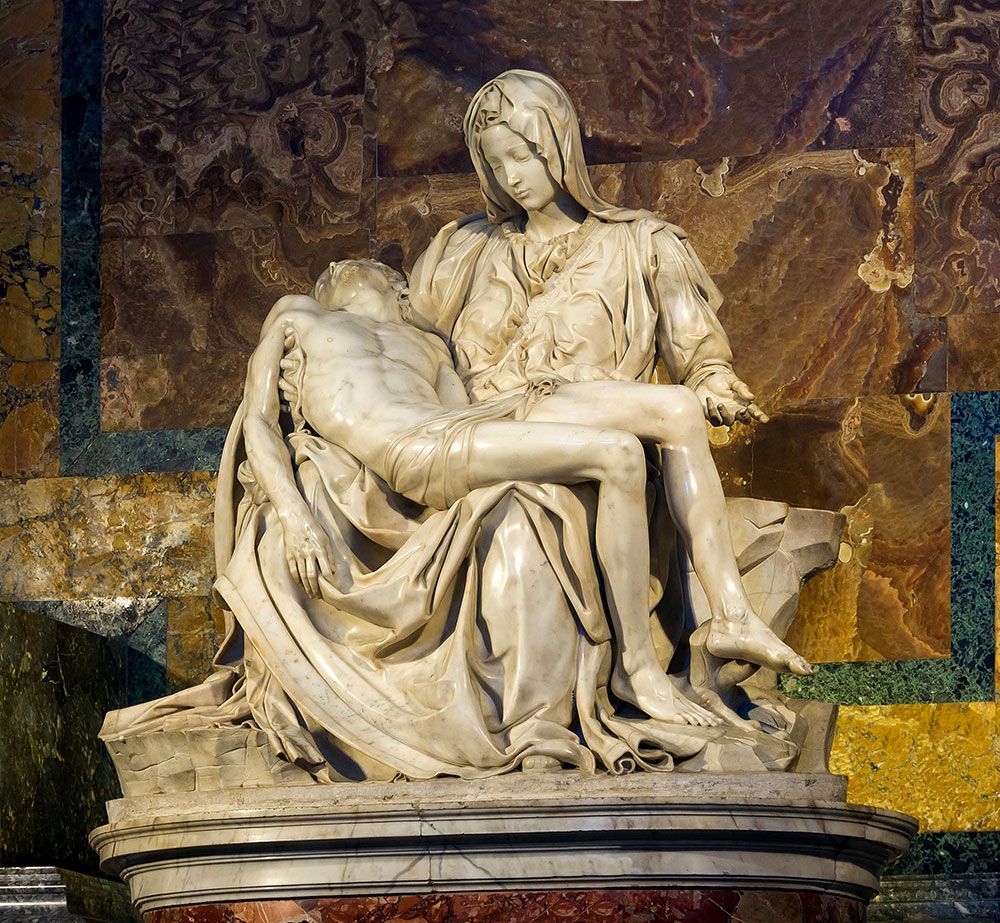
2. Comfort restoration’s heroes
This second characteristic is described as:“…the attitude of wanting to comfort the many sages and righteous people, especially Jesus, who walked the path of restoration with God. To comfort them leads to giving God comfort, who shared pain and sorrow with them.”
• New Essentials of Unification Thought, p. 313
Here’s a timeless piece that’s worth a thousand words:
3. Express deeds of history’s persecuted righteous
This third characteristic is:
“…the attitude of wanting to express the deeds of the good and righteous people of the past and present. …(and) of cooperating with God’s providence by portraying the deeds of those people who were, and still are, persecuted by the people in the sinful world.”
• New Essentials of Unification Thought, p. 313
Here are a couple of such films that come to my mind:


Gandhi, 1982 |
King, 19704
4. Encourage hope and confidence
This is the intention to:“…herald the coming of the ideal world. (and to) create works …which express hope for and confidence about the future. Through such works, God’s glory can be manifested…”
• New Essentials of Unification Thought, p. 313–314
Here’s a very inspiring clip that I found our young adults really appreciated. It’s in the second film of the Lord of the Rings trilogy, when things are at their bleakest and the protagonist’s endurance and will is exhausted. In case you’re curious, the scene dialog is here.
In the same vein, here are some words of Father Moon that also radiate hope, overcome despair and inspire courage:
“You might think that the reason I can work so tirelessly is because I was born different, as if my body were made of steel, But that is not the case. Why would I do this work if it brought me nothing that I liked? Try and do work that you do not like for one or two years. That is like dying. There is a reason I am doing this, despite all sorts of hardships; it is because there is something so real, something so worthwhile, that is calling me to continue.”
• Chambumo Gyeong, Book 7, Section 6
5. Inspire awe of nature’s beauty and mystery
The last characteristic is described this way:
“God created nature for humankind’s joy. Due to the fall, however, people…obtain less joy from the beauty of nature. …(the creative person) should discover the profound and mysterious beauty of nature, praise the mystery of God’s creation, and give joy to others.”
• New Essentials of Unification Thought, p. 314
Here are some exceptional short films that do exactly this. (Please make sure your audio is turned up :)
- Duet, by Glen Keane
- Yosemite Range of Light
There’s no mistaking the profound reverence here.
…and those are the five characteristics of object consciousness that Unification Thought identifies for us. To recap, here’s a figure inspired by Dr. Lee’s original diagrams:
One very significant outcome
Unification Thought explains something that caught my attention because it confirmed an experience I’d often had during my own work and play:
“(Creators) who have such an object consciousness and invest all their energy into their creative work, can receive blessings from God and assistance from the spirit world. …Such works may be considered to be the fruit of a co-creative effort between God and the (person).”
• New Essentials of Unification Thought, p. 314
Again, I should stress that this phenomenon isn’t just for “artists”. As was quoted at the start of this article, it applies to the much broader context of creativity: Beyond the arts, blessing and inspiration can come to someone with object consciousness in such disparate fields as industrial production, commercial enterprises, farming, and scientific research. Indeed, accomplishment and enjoyment can come through many avenues.
Conclusion
I don’t at all expect that we would explain object consciousness and its characteristics to a young child and expect them to remember and practice them. Although I’ve committed them to memory, I don’t measure everything I do against a checklist. But by consistently striving to nurture object consciousness in my heart, I hope that these qualities will increasingly manifest in my work as the years and decades pass. I’m sure that’s what Heaven, my parents and my teachers would want for us and certainly for our descendants.
So it’s important for we elders to appreciate the valuable insight that Unification Thought gives into the motives that drive Father and Mother Moon’s work. It’s something that we hope our young ones will one day understand. And we can pray that when that happens, they’ll carefully nurture this mindset and practice it diligently in their own life and work. Ideally, it’d someday become second nature.
After all, the first original nature is to see from God’s standpoint—and that’s what objective consciousness and these attitudes represent: the original way of looking at life. And as we nurture the original nature of generations of our young ones, the foundations of a new world can unfold.
In the next article, we’ll conclude our look into this beautiful gift of our divine creativity.
Endnotes
1. This series’ purpose is to offer the perspective of Unification Thought on raising our grandchildren. Our basic premises come from 1) the Realms of True Love—in which Father and Mother Moon explain the five realms of divine love—and 2) the Three Great Kingships—which inspires the title of this series. If you take a look at those two links, you’ll at least understand the perspective of the preceding 17 articles, if not the details.
2. In the Unification Thought Theory of the Original Human Nature, and even earlier in the chapter on The Original Image, the Divine Character is composed of Heart, Logos, and Creativity. We had touched on this two articles earlier, here
3. UT calls this mindset “connected body consciousness”. It applies because every person stands in two positions simultaneously: as an object to someone and as a subject to someone else. That reflects the fabric of our human inter-connectedness.
4. I recall that Father Moon once called the Rev. Dr. Martin Luther King the greatest American of the 20th century.
5. The dialog of this scene:
Frodo: I can’t do this, Sam.
Sam: I know. It’s all wrong. By rights we shouldn’t
even be here. But we are. It’s like in the great stories,
Mr. Frodo. The ones that really mattered. Full of darkness and
danger they were. And sometimes you didn’t want to know the
end. Because how could the end be happy?
How could the world go back to the way it was when s o much bad had
happened? But in the end, it’s only a passing thing, this shadow. Even
darkness must pass. A new day will come.
And when the sun shines it will shine out the clearer.
Those were the stories that stayed with you. That meant something.
Even if you were too small to understand why. But I think, Mr. Frodo,
I do understand. I know now. Folk in those stories had lots of
chances of turning back only they didn’t. They kept going.
Because they were holding on to something.
Frodo: What are we holding on to, Sam?
Sam: That there’s some good in this world,
Mr. Frodo. And it’s worth fighting for.
| Gerry Servito was appointed by Dr. Sang Hun Lee to the Art and Culture section of USA’s Unification Thought Institute. Currently, he’s Senior Teaching Fellow of RIIWT. He found Unification Thought after spending college looking into philosophy (esp. existentialism), the Gita, and doing transcendental meditation. He was very grateful to find a spiritual path that pursues not only centered mind-body unity, but a 2nd and even a 3rd Blessing—all for the greater purpose! A granddaughter arrived on Oct. 6th. |