Appendix
During the time in which I was arranging Rev. Sun Myung Moon’s many ideas, he continued to express many new teachings and insights. So I would like to explain here “the principle of mutual existence, mutual prosperity, and mutual righteousness,” which are introduced in the Divine Principle. I would also like to introduce certain especially important topics: the “three great subjects thought,” the “four great realms of heart,” and the “three great kingships.”
I. Principle of Mutual Existence, Mutual Prosperity and Mutual Righteousness
The principle of mutual existence, mutual prosperity and mutual righteousness is a principle addressing a certain dimension of Rev. Moon’s concept of Godism, namely, the dimension including economics, politics and ethics. It is a compound principle consisting actually of three concepts: mutual existence, mutual prosperity, and mutual righteousness. In order to understand the meaning of the principle of mutual existence, mutual prosperity and mutual righteousness correctly, it is helpful to understand each concept in turn. Thus, I will explain one by one.
A. Principle of Mutual Existence
The principle of mutual existence is a concept dealing with the economic aspects of an ideal society, especially the aspect of ownership. In terms of ownership, in capitalist economy there is private (individual) ownership, while in socialist economy there is social (national) ownership. Yet, in both economies the element of love is totally excluded. That is to say, whether private or socialist (public), economy is simply materialistic ownership, without regard to the mental aspect.
In contrast, in the principle of mutual existence, joint ownership is based on God’s true love. In other words, it is first, the joint ownership of God and myself; second, the joint ownership of the whole and myself; and third, the joint ownership of my neighbors and myself. It is not simply a materialistic ownership, but rather it is an ownership based on God’s true love. This means that, through God’s infinite love, we (myself, my neighbors, and the whole) are entrusted to jointly take care of God’s property, which is given to us as His loving gift.
According to the principle of creation, the created world is God’s possession, and it was created to be governed by Him through love (DP, 64). It is written in the Bible that God, the Creator, let birds fly above the earth, and He let the waters swarm with fish, and He made the beasts of the earth (Gen. 1:20-25). This means that the sky is the joint possession of all birds, the waters are the joint possession of all fish, and that the ground is the joint possession of all beasts, all based on God’s love.
Even birds of prey, like eagles, will not monopolize the sky. Even beasts of prey, like tigers, will not monopolize the ground. Even violent sharks will not monopolize the sea. Since God endowed human beings with the right to have dominion over all things with love, all human beings were to jointly possess the sky, the sea, and the land, as well as all living beings, including birds, fish and beasts, with a heart of gratitude, based on God’s true love. Thus, nature is the joint possession of God and human beings.
Nevertheless, due to the fall, human beings fell into self-centered individualism, and came to monopolize land and property. Today, under the banner of liberal democracy, people legally possess vast lands and enormous amounts of property. Yet, they are not usually very grateful; they seldom experience any pangs of a guilty conscience. Even when they see their neighbors starving, they often do not seem to care, and just continue to live arrogantly; this is characteristic of capitalist society. They are basically living their lives against the Way of Heaven.
The relationship between God and human beings is that of parent and children, the basic form of which is realized in a family. In a family, all property—such as the house, the garden, the yard, cattle, and so on—belongs to the parents, and at the same time to the children. In other words, in a family, even if the property is legally possessed by the parents, in fact, it is jointly possessed by both parents and children. In the original world, parents always love their children; therefore, children always have a heart of gratitude towards their parents and take good care of the family property.
In the basic form of the family the three generations of grandparents, parents and children (brothers and sisters) live together. Therefore, joint ownership is, strictly speaking, joint ownership of the three generations: namely, the joint ownership of grandparents, parents and children, all based on true love. Here, since the grandparents are in the position representing God, the joint ownership of the three generations can be expressed as the joint ownership of God, who is the subject of true love, parents, and children. The family joint ownership in which three generations possess things together, is the prototype for various other kinds of joint ownership. Thus, joint ownership in the principle of mutual existence is the joint ownership of God and I, the whole and I, and my neighbors and I, all based on God’s true love. It is the joint ownership of all three levels of the other and I. In short, it may be called “the joint ownership of God, the whole, my neighbors, and I.”
An extension of this joint family ownership is the joint ownership of various other organizations. For example, the joint ownership of a company is the joint ownership of three parties: God, who is the subject of true love, the executives, who are in the position of parents, and employees, who are in the position of children. Therefore, it is the joint ownership of the three levels of “the other and I,” namely, “God and I,” “executives and I,” and “my fellow employees and I.”
In the original world, even when a company is founded by entrepreneurs, it should first be offered to God. After it is offered to God, thus becoming God’s possession, it is returned to the entrepreneurs with God’s true love; then, it will be possessed jointly by the entrepreneurs and God. Such a procedure is more than a mere formality. Only through such a procedure can God’s true love, protection and help effectively come to a company. The same thing can be said of other organizations as well.
Next, let me explain about joint ownership on a national level. In the case of a state-owned enterprise, for example, all properties are under the joint possession of the state and the people. It is the joint possession of the three parties of God, who is the subject of true love, the president or the sovereign of the country, and the employees of the enterprise; also it is the joint possession of the three levels of “the other and I,” namely, “God and I,” “the president and I,” and “the employees and I.” Here, God’s love, protection and help can be given; the president will give affectionate concern and assistance; and the employees will be thankful to God and to the president, and they will take good care of all property with a consciousness of joint ownership. This is the concept of “joint ownership on a national level.”
Here, one might raise the question; “Is not there any private ownership in the ideal world?” Yes, there is, and it is proper that there should be. This is because a human being, in resemblance to God, has both a universal image and an individual image. That is to say, a human being has a common attribute (universality) and at the same time, an attribute peculiar to himself or herself (individual image). A human being has dual purposes: the purpose for the individual and the purpose for the whole, as well as the desire and freedom to practice love. Thus, private ownership is allowed. I will explain this using the case of joint family ownership, which is the prototype for various other joint ownerships.
Let’s take the example of the family of a farmer. It is for pursuing the purpose for the whole that family members jointly take care of, and keep, the family property, i.e., house, garden, field, cattle, and so on. In other words, all the family members jointly seek the life of food, clothing, and shelter. They do so, living under the same roof, spending the same budget. Yet, each member of the family has his or her own unique individuality (individual image). Thus, he or she will lead his or her own way of life according to his or her situation, tastes, and so on. Also, in many cases, children need a room, clothes, or other living necessities for their exclusive use in the same way that parents do. So, parents will give allowances to their children. This kind of personal possession is necessary for them to accomplish their individual purpose.
Private possession is necessary to accomplish the purpose for the individual, and at the same time, it is necessary to accomplish the purpose for the whole as well. The purpose for the whole is accomplished through a community life or a family life, by using the jointly owned property; at the same time, it is accomplished through personal ways by using personal property.
When children try to comfort and please their parents, they are fulfilling the purpose for the whole. For example, in order to please parents, an elder brother reads many books, which are his possessions, and gets good grades at school; a younger brother paints a beautiful picture using painting instruments, which are his possessions, and gets a special prize at an art exhibition; an elder sister plays the violin, which she possesses, and receives the highest praise from the audience at a concert. In these cases, they fulfill the purpose for the whole through their personal possessions.
In this way, private possessions are necessary not only for accomplishing the purpose for the individual but also for accomplishing the purpose for the whole. Thus, human beings are endowed with desire, love, and freedom in order to love others (to realize the purpose for the whole) according to their free will, investing their unique individualities and personal possessions.
Then, to what extent is personal possession reasonable? This is determined according to the appropriate necessity of each person. This kind of possession is called appropriate possession. The proper quantity and quality will be determined according to one’s own conscience. Rather differently from the case of fallen people, an original person will easily understand the quantity, quality, and kinds of his or her necessary personal possessions.
We often express the psychological amount—the amount of desire, gratitude, satisfaction and so on—through material means. For example, when we receive kindness from others, we often express gratitude with a kind of gift, or a sum of money. Similarly, in the case of private possessions, a psychological amount which one feels appropriate to oneself can be expressed through a material amount. No one other than oneself, can best express one’s psychological amount in a material amount. Thus, a psychological amount which is appropriate to oneself can easily be determined by oneself. When we have meals, we know our condition well: if we eat little, our physical strength will become weak, and if we eat too much, our stomach will have trouble. Similarly, if our conscience is pure, God will show us through our conscience the psychological amount appropriate for our personal possessions. Thus, the appropriate possession of private property can be easily determined.
It should be clarified here that even if the proper quantity and quality of one’s private possessions are determined through one’s conscience, that quantity and quality may vary from person to person. There are certain reasons for that. First, each person has his or her unique individual image, and therefore unique character, taste, and so on. Second, every person is an individual truth being and at the same time a connected being. A connected being refers to an individual person who is related to others in the six directions of high and low, front and back, and right and left. In order to have such relations, a person, as a connected being, requires at least a certain necessary quantity of personal possessions. Usually, the higher the position a person occupies, the greater the quantity and quality of his or her necessary possessions become. Therefore, the proper quantity and quality of personal possessions will differ from person to person. Thus, if a person has adequate personal possessions necessary to love others, then, those possessions are appropriate, even if the amount of his or her personal possessions is substantially higher or lower than the average.
In this way, the principle of mutual existence is the theory of joint economy based on joint ownership. The concept of economy here refers, first, to the totality of activities related to the production, exchange, distribution, and consumption of goods through primary, secondary, and tertiary industries, in the same way as it does in conventional economic theory. However, since the economy in the future world is based on joint ownership centered on God’s true love, as already explained, economic activity in the future world will be quite different from the economic activity up until today. To explain briefly, all economic activities are the unity of spiritual processes, which are the flow of heart, love, gratitude, and so on, and the material process, which is the circulation of commodities. The commodity itself is a united being of spirit and matter where love and sincere heart dwell, and the circulation of commodities is also the unity of spiritual processes and material processes where love and a sincere heart circulate.
Since the future world will be a unified world without national boundaries, the future economy will be one global economy in which regional bloc economies are organically and harmoniously united. In other words, a unified industry will be established, in which local, special industries fitted for particular regions and non-local, universal industries are harmonized and unified. This is a conclusion derived from Unification Thought, which states that every being is a united being in which the universal image (universality) and individual image (individuality) are unified.
In future industry, an enterprise will seek to contribute to the progress of the welfare of all humankind rather than aiming only for the interest of the entrepreneurs. Therefore, the overall result of industrial activity will be the multiplication of beneficial goods for humankind.
In the future, society’s most serious economic problem, which must be solved, is the food problem, since the population is increasing in a geometric progression. Thomas Malthus expressed concern about this problem in his An Essay on the Principle of Population as It Affects the Future Improvement of Society, and the Club of Rome also warned about this problem back in the 1970’s. However, this difficult problem will be solved through the development of the marine industry—based on the development of aquaculture, and so on. This is a conclusion which is derived from the Divine Principle, according to which the ocean symbolizes a woman, and a woman’s important mission is fertility or production.
B. Principle of Mutual Prosperity
The principle of mutual prosperity is concerned with the political aspects of the future ideal society. Especially, the principle of mutual prosperity is proposed as an alternative to democracy, which is the political ideology of capitalism. As is well known, democracy in capitalist society is a liberal democracy, a political ideology associated with the slogan “life, liberty, and the pursuit of happiness” in the Declaration of Independence of America and the slogan “freedom, equality, and fraternity,” which derives from the French Revolution.
Democracy is an ideology wherein “sovereignty rests with the people.” This is well-expressed in his famous Gettysburg Address by Abraham Lincoln, the sixteenth President of the United States, as the “government of the people, by the people, and for the people.” Essentially, democracy is an ideology seeking to realize freedom and equality for all people. In other words, the ultimate purpose of democracy, which claims majority rule and parliamentary government, is the realization of freedom and equality for people. Freedom and equality are like two sides of a coin: there is no equality without freedom, nor is there freedom without equality.
Then, what is meant by the “people”? In the days of bourgeois revolutions, the people were the ruled class under an absolute monarchy. Today, however, “people” generally refers to the masses, transcending social classes. The ruling class is often dictatorial; therefore, it can be said that people means “the majority of the people,” those apart from the ruling class, and the wealthy, privileged class as well.
Over two hundred years have passed since democracy was established. Have freedom and equality of the people been realized? It certainly seems that they have not been. Due to its structural contradiction, capitalism, which was established based on liberal democracy, has brought about economic inequality and the restriction of economic freedom, along with an uneven distribution of wealth. We have also witnessed in history many cases in which economic inequality and the restriction of economic freedom were directly connected to political inequality and the restriction of political freedom.
Especially the freedom and human rights of the majority of the people — the lower class — are often apt to be trampled upon under the name of democracy. Therefore, the sovereignty of the people exists only in name. Actually, freedom and human rights are utilized for the special interests of politicians, who spend enormous amounts of money to get elected. Today, an election campaign is hardly more than a political contest for concessions. Thus, democracy has failed to become a genuine “government of the people, by the people, and for the people”; rather, it has become almost like a “government of the party members, by the party members, for the party members.” Due to this deficiency of liberal democracy, Communists accused it saying, “it is no more than a bourgeois democracy for the ruling and wealthy classes, rather than for the people.” Since World War II, they maintained that Communism for laborers and farmers is the true people’s democracy.
What is the reason why democracy, which aimed at the realization of true liberty, equality and fraternity, has failed to realize its purpose for more than two hundred years? The main reason is that democracy, which was established by overthrowing absolute monarchy through bourgeois revolution, was closely united with individualism; it has claimed the rights, freedom, and equality of an individual person. Individualism is to be respected in that it emphasizes the importance of individuality, personality, and individual values. Due to the policy of the separation of church and state, however, Christianity, as a guiding principle for the human spirit, became unable to function, and as a result individualism degenerated into egoism. Thus, democracy came to be established on the basis of egoistic individualism.
Since egoistic individualism rules the minds of economists and politicians, capitalists perpetually pursue the maximization of profit, and politicians regard political power as their concessions. Today, politicians invest enormous amounts of money for elections with the spirit of investing to acquire concessions, in the name of fair elections. So, due to entrepreneurs’ persistent pursuit of profit, and politicians’ insatiable desire for power, corruption, and various kinds of injustices and crimes are rampant in democratic society today.
This means that democracy had, from its very beginning, inherent limitations on the realization of its slogan of liberty, equality, and fraternity. Democracy, in which religion and politics are separated, has the inevitable tendency for individualism to degenerate into egoism. However, it is not that liberal democracy has failed in every respect. Clearly, it has played an important role in securing freedom of faith. In fact, in liberal democratic countries, the flowers of religion and faith are in full bloom, in the same way that many flowers bloom in the spring time.
Here, let me explain about the significance of the emergence of democracy, as seen from the viewpoint of God’s providence. It is in accordance with God’s providence that democracy has secured freedom of faith, since democracy is a political system that emerged prior to the Messianic Kingdom. It should be noted that democracy was established by the bourgeois revolution, which overthrew the existing absolute monarchy. If the political system of those days had not been an absolute monarchy, but had been the Messianic Kingdom, realizing God’s true love, the bourgeois revolution would not have occurred, and humankind would have lived happily, enjoying true liberty, equality and fraternity. The above-mentioned presupposition that “if it had not been an absolute monarchy but had been the Messianic Kingdom” is not a mere assumption. Seen from the viewpoint of God’s providence, the Messianic Kingdom was already supposed to have been established by that time. Let me explain this point more concretely.
Charlemagne (Charles the Great) developed the Frankish Kingdom and revived the Western Roman Empire from the end of the eighth century through the early ninth century. Seen from God’s providence, Charlemagne, in the New Testament Age, is the figure who corresponds to King Saul of the Jewish United Kingdom, in the Old Testament Age. The prophet Samuel anointed Saul with oil as the first king of Israel about 800 years after Abraham. Similarly, Charlemagne was crowned by Pope Leo III as the emperor of the Western Roman Empire about 800 years after Jesus. According to the Divine Principle, the Frankish Kingdom, from Charlemagne’s enthronement until the end of the Carolingian reign, is called the Christian Empire, which corresponds to the Jewish Kingdom in the Old Testament Age.
It was God’s providential will that the First Coming of Christ come to the Jewish Kingdom in the Old Testament Age to unify the world and establish the Kingdom of the Messiah, centered on God’s true love. In the New Testament Age, it was God’s providence that Christ at the Second Advent come to the Christian Empire to establish the Kingdom of the Messiah, centered on God’s true love.
In the Jewish United Kingdom of the Old Testament Age, the kings failed, throughout the three generations, to establish providential conditions in accord with God’s will; therefore, God divided that kingdom into two: Israel in the north and Judah in the south. Eventually, God allowed the northern kingdom to be occupied by Assyria, a Satanic kingdom, and the southern kingdom to be occupied by New Babylonia. The Jewish kings were made prisoners. Thus, God’s providence for establishing the Messianic Kingdom through the Jewish Kingdom ended in failure.
Likewise, since the kings of the Christian Empire, in the New Testament Age, failed to establish providential conditions in accord with God’s will, the Christian Empire was divided into Eastern and Western Kingdoms, and finally came to endure the hardships of the Crusades, and the Popes’ captivity in Avignon. Also, due to the failure of the kings of the Christian Empire, Satanic absolute monarchies appeared.
Thus, God’s providence to establish the Kingdom of the Messiah on earth by receiving the Messiah at the time of the Christian Empire failed in the same way as it had in the Old Testament Age. However, God’s providence to establish the Kingdom of the Messiah continued in force, and a new providence to receive the Messiah was initiated. That was the providence to receive the Messiah through the will of the people—from the bottom. This kind of providence appeared in both the Old Testament Age and the New Testament Age. In order to receive the Messiah through the will of the people, Satanic kingdoms and monarchies which obstructed God’s providence had to be overthrown, and a social environment created, in which the people’s will could freely be manifested. Thus, God universalized democracy, wherein each person would be respected.
In the Old Testament Age, God established Persia, a gentile nation on Abel’s side, and let it overthrow New Babylonia, which had captured the Israelites, and thus enabled the Israelites to return home. Then God, sending the prophet Malachi, started the providence of the preparation to receive the Messiah. At the same time, He left the throne of the king of Israel vacant and put the Israelites under the Hellenistic cultural sphere from the end of the fourth century BC. Since the Hellenistic culture was based on democracy, which respects individualities, the Israelites were able to express their own opinions freely under this culture. Thus, it became possible to receive the Messiah through the will of the people. According to the Divine Principle, this type of society is called a “society in the form of democracy” (DP , 332). -RESUME
God conducted a similar providence in the New Testament Age: He arranged for the Satanic forces, which were obstructing God’s providence, to disintegrate and decline. At the beginning of the sixteenth century God inspired Martin Luther to initiate the Protestant Reformation in order to awaken Christianity, which had been secularized by Satan. Then, from the end of the sixteenth century through the end of the eighteenth century, He allowed the Enlightenment to spread throughout Europe. This was a movement against the authority, privileges, social restrictions, and inequalities of the old regime, while yet maintaining respect for human reason. On the basis of the Enlightenment, God allowed the French Revolution, the slogan of which was “liberty, equality and fraternity,” to occur, and He arranged for the Satanic absolute monarchies to decline. Thus, in this way modern democracy was established. Yet, as mentioned above, democracy is a political ideology established in order to receive the Second Advent of the Messiah through the will of the people; it is not an ideology able to actualize true liberty, equality, and fraternity.
Historically, religions had certain shortcomings, including a disregard for the individuality, freedom, and rights of human beings. Therefore, democratic governments felt it necessary to implement the policy of the separation of religion and politics. As a result, the absolute standard of value which the human spirit should follow came to be lost, and as a matter of course, democracy degenerated into egoistic democracy. Thus, in democratic society, the great confusion which we see today came about.
Actual problems of all kinds can be solved fundamentally only with God’s truth and true love. Therefore, it will be possible to solve all problems fundamentally only when the Kingdom of the Second Advent of the Messiah, who will come with truth and true love, is established. I have so far pointed out the limitations of liberal democracy when seen from the viewpoint of God’s providence. I have also noted the fact that democracy, to its great merit, has fulfilled its responsibility in guaranteeing freedom of faith, so that people can freely receive the Second Advent of the Messiah, according to their will.
The principle of mutual prosperity is, in short, a theory concerning joint government. Joint government refers to a government achieved through “the joint participation of all people.” The joint participation of all people is an ideal which represents the ideology of democracy in the true sense. The joint participation of all people is, in fact, a people’s participation through their election of their representatives. Then, if participation in politics through elected representatives is joint politics according to the principle of mutual prosperity, one may ask the following question: “How is this different from present democracy?” There is one basic difference between them, which we must now consider.
A joint government under the principle of mutual prosperity would have the following characteristics. First, the relationship among the candidates would not be that of rivalry, but that of brothers and sisters attending the Messiah, the representative of God, as the true parents of humankind. Second, the candidates would run for election not by their own will, but rather with the recommendation of many neighbors (brothers and sisters), namely, by the will of others, since those who are in the relationship of brothers and sisters centered on true love will make mutual recommendations. Third, an election would not take place in a way that would require an enormous expenditure of money, with all the accompanying side effects. After a preliminary election in the first stage, an election by lottery would be made in the second stage, accompanied by solemn prayer and appropriate formality. With the assurance and confidence that the outcome was in accord with God’s will, those elected, those not elected, and, in fact, all the people, would be thankful to God, and could accept the result happily and sincerely.
In this way, a joint government under the principle of mutual prosperity is a government conducted through the joint participation of the people, based on God’s true love. It would be the government of the Kingdom of the Messiah, in which the entire world can be unified. Also, since all people would attend the Messiah, the representative of God, as the True Parents of humankind, and participate in the joint government as brothers and sisters who have inherited the love of True Parents, a joint government will be a “government of the brothers and sisters, by the brothers and sisters, and for the brothers and sisters, centered on the True Parents of humankind,” rather than “government of the people, by the people, and for the people.” To be specific, a government under the principle of mutual prosperity is not a democracy, but rather a government of brothers and sisters centered on Heavenly Father.
True liberty, equality, respect for human rights, fraternity, and so on, all of which are the aims of democracy, but unrealized even today, can be realized completely through a government of brothers and sisters centered on Heavenly Father. In this sense, joint government under the principle of mutual prosperity can be expressed as a fraternal democracy. It should be noted that the sense of brotherhood described here has a different meaning from the common sense meaning: we are not referring to a brotherhood confined within a national boundary, thus creating regional brothers and sisters, as we see today. The brotherhood I am talking about is a universal brotherhood, in the true sense, wherein the entire world is united into one nation of brothers and sisters, and all humankind, as children, attend the True Parents, the center of humankind.
The reason why the idea of universal brotherhood has not been realized even today is that, first, the unification of the world has not yet been accomplished, and second, the True Parents of humankind had not appeared. The same thing can be said of democracy. The reason why democracy has not yet been fully realized is that-other than the reasons mentioned above-democracy, which is originally a supra-ethnic and supranational idea, is, in reality, restricted by ethnic and national characteristics.
A similar thing can be said concerning the Kingdom of the Messiah. The Kingdom of the Messiah is not a regional kingdom, but rather it is a supra-ethnic and supranational kingdom. The advent of the Messiah takes place in one elected nation, which is a regional nation, whereas the establishment of the Kingdom of the Messiah is possible only after the world is unified. It needs to be said, however, that the principle of mutual existence, mutual prosperity and mutual righteousness can be realized to some extent, even before the actual unification of the world, if the leaders of the world are willing to make an effort, attending God as the True Parents. By their doing so, a temporary solution of various kinds of confusion we experience today would be possible. Thus, I would say that the actual society functioning fully under the principle of mutual existence, mutual prosperity and mutual righteousness, will be established only after the present time of capitalism.
Finally, let me explain about the relationship between such a joint government functioning under the principle of mutual prosperity, and the separation of three powers. Democracy is a constitutional government, whose essence is the separation of the three branches of government: the legislative, the judicial, and the executive. Following this tradition, a joint government under the principle of mutual prosperity is a government by the representatives wherein the separation of the three powers is practiced.
However, the separation of three powers under the principle of mutual prosperity is not exactly the same concept as that proposed by Montesquieu, who sought to avoid any abuse of power. Under the principle of mutual prosperity, a separation of the three powers is proposed, but more in the sense of a division of the work of the three branches, legislation, judicial, and administrative, all working in harmony. The concept of power in the principle of mutual prosperity is also different from the traditional understanding. The traditional concept of power refers to physical force with which to subjugate people; but in the principle of mutual prosperity, power refers to an authority with true love, which inspires the object (people) to gratefully and willingly obey the will of the subject (sovereign).
While exercising their own physiological functions in harmony with each other, the various organs in a human body cooperate for the common purpose of supporting the life of the human body. Similarly, based on the common ideal of the country, the three branches will form an organic and harmonious system of cooperation, as they carry out the three functions of legislation, judicature and administration for the existence of the country.
According to the Divine Principle, the legislative, judiciary, and executive branches, which are all in a cooperative relationship with one another, are compared respectively to the lungs, heart, and stomach of the human body. The peripheral nerves connected to various organs in the human body cooperate with one another, harmoniously fulfilling the physiological functions of the human body, according to the commands of the brain. Similarly, in the ideal society, the will of God, who is the true subject of love, will be conveyed to the legislative, judicial, and executive branches through the organs of communication, and these three branches will cooperate harmoniously.
It should be clarified here that in God’s creation the ideal image of the Kingdom of Heaven on earth was conceived in God’s mind by taking the human body as a model. Therefore, the structure of the state in the ideal world resembles the structure of the human body. I explained above that the legislative, judicial, and executive branches are compared respectively to the lungs, heart and stomach; as a matter of fact, these three branches were established by imitating the lungs, heart, and stomach.
Due to the human fall, nations lost their original character, and became non-principled nations. Yet, the framework of a nation still resembles the structure of the human body. Thus, in the same way that the structure and function of the organs (lungs, heart, and stomach) of the human body are unchangeable, the structure and the function of the three branches of legislation, judicature and administration are unchangeable in the principled world. What should be added here is that the realities of the three branches in the ideal world are not identical to today’s non-principled ones. In fact, principled power and non-principled power are very different in that the former is based on an emotional force of true love, whereas the latter is based on a compulsory force of physical power.
C. Principle of Mutual Righteousness
The principle of mutual righteousness refers to joint ethics. This is the perspective needed for the realization of an ethical society, namely, a society of joint ethics, in which everyone observes and practices morality and ethics, both publicly and privately. Today, regardless of there being a capitalist or Communist society (including the ex-Communist societies), morality and ethics, which people should observe, have all but collapsed. As a result, various injustices and social crimes are rampant, and the world is now sunk in great confusion. Many people deplore this collapse of values, but no one seems to be able to offer any effective measures for revitalizing those values.
The principle of mutual righteousness is an ideology capable of terminating this collapse of values, and of establishing a healthy society on earth, wherein everybody freely observes morality and ethics everywhere and at all times. The ideal society, which is to come after both the capitalist and communist societies, will be the society of mutual existence and mutual prosperity as explained above and, at the same time, it will be the society of joint ethics, where all people, regardless of their positions, will live with the same ethical attitudes. The principle of mutual righteousness is the very core of the future society of mutual existence, mutual prosperity and mutual righteousness. More concretely, and this will be explained shortly, the society of mutual righteousness will be the society in which the three great subjects thought is fully practiced.
In the future ideal society, religion will not be necessary, since the purpose of religion will have been completely realized. The purpose of Christian teaching is to empower an individual to firmly maintain faith until he or she receives the Second Advent of the Messiah. The purpose of Confucianism is to empower people to practice virtue until the ideal world of universal brotherhood arrives. The purpose of Buddhism is to empower people to train themselves and observe the law (Dharma) until the ideal world — the Realm of the Lotus-store (the World illuminated by the Buddha of Perfect Enlightenment) as taught in the Hua-yen (Kegon) School — arrives. Islam seeks a theocracy centering on the sovereignty of Allah. Therefore, the purpose of Christianity will be achieved when the ideal world of creation is realized by receiving the Second Advent of the Messiah; the purpose of Confucianism will be accomplished when the world of universal brotherhood is realized; the purpose of Buddhism will be accomplished when the Realm of the Lotus-store is realized; and the purpose of Islam will be realized when the theocracy centering on the sovereignty of Allah is realized.
The world in which the purpose of all religions has been accomplished is the society of mutual existence, mutual prosperity and mutual righteousness, namely, the society centered on the Second Advent of the Messiah. The teachings of the Second Advent of the Messiah embrace the core teachings of Christianity, Confucianism, Buddhism, and Islam. Therefore, there is no further need for any religion to persist. The society of mutual existence, mutual prosperity and mutual righteousness is not merely an instructive, ideal society, as traditional religions have taught, but rather the society in which people will lead a life of true love; a heavenly life in the midst of reality together with the Messiah. In that society, all people will live with the same values; therefore, religious doctrines centered on faith will be transformed into, and consummated as, living ethics centered on practice. This aspect of the future society is called the society of joint ethics, namely, the society of mutual righteousness
Then, what will be the characteristics of the society of joint ethics- First, social life will be reinforced by the true love of the three great subjects based on the three great subjects thought. Primarily, the three great subjects-namely, parents, who are the center of the family, teachers, who are the center of the school, and managers or leaders (company presidents, leaders of organizations, heads of state), who are the center of dominion-give God’s true love continuously and limitlessly to their object partners, namely, children, students, employees or the people of their country, all based on the three great subjects thought. Subsequently, mutual love among object partners will be induced, and the entire society, a highly ethical society, will resemble, metaphorically speaking, a garden of love.
Various inequalities will disappear with the practice of true love. Poverty will disappear through the true love of those who have more. Those who are thirsty for knowledge will be satisfied through the true love of those who have knowledge. Those who were alienated in the workplace will be consoled by the true love of the manager. Inspired by God’s true love, we can not but feel like helping those in need. This is what it means to say that the society will resemble a garden of love, and will be an ethical society.
A school filled with the teacher’s true love, and a workplace filled with the manager’s true love will both become ethical systems, which are the extended forms of an ethical family. That is to say, a school filled with the true love of a teacher is how a family filled with the true love of parents is extended in the aspect of education; a workplace filled with the true love of a manager is an extended family in the aspect of management. Thus, the entire society will be filled with God’s love. This is the society of mutual righteousness. Thus, the society of mutual existence, mutual prosperity and mutual righteousness will be the social system based on the three great subjects thought.
Second, the basic unit of the society of mutual existence, mutual prosperity and mutual righteousness is the family. In other words, the practice of the loves of the three great subjects is first realized in a family. There are four positions in the family, i.e., the positions of grandparents, parents (husband and wife), children (brothers and sisters), and grandchildren. God’s love is given and received between the various members of a family who are in these four positions. Thus, grandparents’ love, parents’ love, husband and wife’s love, brothers and sisters’ love, and children’s love are all fully realized in the family. When these kinds of love are given and received in the family, family law and family order will naturally be established. With the establishment of family law and family order (norm), a peaceful family, filled with compassion and harmony, will be realized. Such a family is indeed an ideal family.
The economical, political and ethical society based on the ideal family is the society of mutual existence, mutual prosperity and mutual righteousness. In this way, the long-cherished desire of humankind and the ideal of many thinkers and religious believers will finally be realized, and the world of the ideal of creation which has been fervently desired by God for over six thousand biblical years will be realized.
Conclusion
I have explained the basic concepts of the principle of mutual existence, the principle of mutual prosperity and the principle of mutual righteousness. My explanations have hopefully clarified that the principle of mutual existence, the principle of mutual prosperity, and the principle of mutual righteousness are not separate ideas but rather they are integrated as one. When this one, integrated idea is realized, the world of the ideal of creation, which God originally envisioned, will be realized for the first time. Thus, we call this one idea the “principle of mutual existence, mutual prosperity and mutual righteousness,” using this single phrase. This concludes my explanation about the principle of mutual existence, mutual prosperity and mutual righteousness. Next, I will explain the concept of the three great subjects thought, the ideology of the ideal family, which is the core of the principle of mutual righteousness.
II. Three Great Subjects Thought
The three great subjects thought is an expression coined by Rev. Sun Myung Moon. The three great subjects refer to parents, teacher, and leader. In other words, the three great subjects mean the three great centers: the parents, who are the center of a family; the teacher, who is the center of a school; and the leader, who is the center of dominion. Here, the center of dominion refers to the center of a group, an enterprise, a country, and so on, namely, the central person who is responsible for management or leadership. Hence, the head of a group (a union, a political party, a federation, etc.), the president of an enterprise, the governor of a province, the president of a country, and so on, all fall under this category of leader. In this way, we call the three centers of parents, teacher and leader the three great subjects. The three great subjects thought emphasizes that these three great subjects should all practice God’s true love.
God’s True Love
God’s love is absolute, since He is the absolute being. The term “absolute” in the sense used here, has a meaning different from any kind of sense carrying a secular meaning. The term “absolute,” as it is used here, connotes the qualities of eternal, unchangeable, limitless, and universal. God is eternal, and omnipresent, existing all the time and everywhere. Accordingly, God’s love is also eternal, and omnipresent. Such love is absolute love, or true love.
True love can be compared to sunlight. There is no place upon which the sun does not shine, and the sun is always shining eternally without rest. Similarly, true love is a comprehensive love, given to all humankind as well as to all things. All created beings are object partners of true love, and nothing in the universe is excluded from the realm of true love. Love was sometimes taken as referring to the intimacy between people, but true love is love given to all humankind, including enemies, and also to all things.
A person is related with other people in the six directions of above and below, front and back, and right and left. Taking oneself as the center, one is related above with one’s parents, superiors, and elder persons; below with children, subordinates, and younger persons; to the front, with teachers, senior colleagues, and leaders; to the back, with students, junior colleagues, and followers; to the right, with brothers and sisters, intimate friends, and intimate colleagues; to the left, with competitors, strangers, and opponents. True love covers all these persons in all six directions. Furthermore, true love extends to all things. The three great subjects thought asserts that we should practice such true love at all times and in all places.
What is love? Love is to seek to care for one’s object partners, while expressing to them a warm heart. With true love, one wants to give what one has to others, rather than to receive things from others. Secular love is a more selfish love, with which one looks after one’s own interests. In contrast, the true love which Rev. Sun Myung Moon teaches is a love with which one expects nothing in return and only wishes to give to others. Thus, in true love, one wishes to continuously give to others, with a warm heart. Then, in what concrete way should we express love to others? There are many ways to love: “to talk gently,” “to understand one’s circumstances,” “to give financial aid,” “to extend cooperation,” “to serve,” “to support,” “to help someone get out of difficulties,” “to embrace,” “to forgive one’s enemies,” “to teach kindly,” and so on. To give, and then to give again to others with a warm heart in this way is the practice of true love. The spirit of this way of life is called altruism, or the spirit of “living for the sake of others.”
True Love of the Three Great Subjects
As explained above, the true love of God is a love with which one wishes to give, and give again, endlessly to others. Just as hot water flows endlessly from a hot spring, so, too, one should endlessly embrace others with the hot-spring-like-water of true love from a warm heart. The three great subjects should always practice such love in their daily life. This is the core of the three great subjects thought. That is to say, parents should express such love to their children; a teacher should express such love to his or her students; and a leader should express such love to his or her subordinates or followers. Then, how do we express true love in the practice of our daily life?
We should practice true love through acting in the role of a subject. The role of parents is to bring up their children. The Korean term for raising children is yangyuk (養育), which consists of two Chinese characters, yang and yuk. Yang means to raise children by giving them food, clothing and shelter. While performing the duty of parents—namely, giving food, clothing and shelter—parents love their children with a warm heart. Yuk means to educate: parents teach their children family law, manners, ethics, morality, and any necessary knowledge, with a deep and warm heart.
In this way, parents can convey to their children the true love of God in the process of raising them. Parents should not love their children merely for the purpose of receiving something back when they have grown up. In other words, parents should not have the idea that they can make money or achieve power through their children. Wishing whole-heartedly that their children will become good, praiseworthy persons, they should raise them with a warm heart. This is the role of the parents. The expression of love when raising their children is the parents’ practice of true love.
The role of a teacher is to teach his or her students through the education of knowledge, technical education, artistic education, physical education, and so on. A teacher should teach students kindly and sincerely. If students raise questions, the teacher should answer sincerely, and if they have any difficult problems, the teacher should help them as much as possible. In this way, a teacher can practice God’s true love. This is the practice of true love in the role of a teacher. To teach only for the sake of wages is simply to sell and buy knowledge. This kind of education is not a correct education, since there is no love invested. A teacher should focus primarily on teaching students with sincerity, setting aside their receiving a salary as a secondary concern. Teaching should aim at the cultivation of the personality of students so that they will be empowered to serve society once they have matured. In order to do this, the teacher him or herself should first of all have a noble personality and a spirit of serving others. It is with the true love of a teacher that the teacher seeks to teach students with such a spirit of service and with a sincere and warm heart. Thus, the true love of a teacher is to practice love in one’s role as a teacher.
Finally, let me explain the true love of a leader as expressed through the role of being a leader. What is the proper role of a leader? The role of the president of a country is to govern the people well and empower them to live well. The role of the governor of a province is to harmoniously govern the province, and the role of the manager of a company is to offer good welfare to employees. Let me briefly explain about the case of a company more concretely. The manager of a company should not have the idea of making employees engage in hard work in order to make money for himself or herself. Of course, a company should make money. However, once the company has made money, managers should return an appropriate share of it to the employees. In the future society, the spirit of making money will be united with the spirit of giving.
The manager of a company should have an altruistic spirit of service. He or she should love the employees and have the spirit of giving with a warm heart. The manager should be concerned about the circumstances of the employees, and whether or not they have any difficulties with regard to food, clothing, and shelter. This is a dominion with love. In many cases, however, dominion includes giving orders to subordinates. An order in itself can feel cold; but when a leader gives an order with a warm and sincere heart, subordinates can receive it with gratitude because the order carries with it such a warm feeling.
The Bible says that God gave human beings the three great blessings. In the third blessing, God ordered human beings to dominate all things with love. The primary, secondary, and tertiary industries, as well as all other activities which deal with materials, fall under the category of dominion over all things. Dominion should be done with love. Thus, we should manage buildings and facilities, regarding them as belonging to all people and to God rather than to ourselves.
Thus, the management and maintenance of properties and facilities should be carried out with a sincere heart. This is the spirit of management as an exercise of loving dominion over all things. Pollution, which recently has become a serious problem, is the inevitable result arising from the loss of the spirit of dominion or the spirit of management with love. The spirit of dominion with love is the practice of the true love of a leader. In summary, the idea that the three great subjects should practice God’s true love through their respective roles is the three great subjects thought.
Three Subjectivities with One Center
Three subjectivities with one center refers to the idea that a central figure serves in the roles of, and practices simultaneously the loves of, the three great subjects, i.e., parents, teacher, and leader. In other words, although parents, teacher, and leader are different roles, nevertheless, parents should be at the same time a teacher and a leader. In other words, parents practice true love through the roles of the three subjects: While parents are primarily fulfilling their role as parents to love their children with a warm heart, they also carry out the roles of teacher and leader.
While engaging primarily in teaching, a teacher also stands in the position of a parent and raises students as if they were his or her own children, and at the same time, the teacher stands in the position of a leader to guide the students.
While engaging primarily in the management of an organization, a leader should also accomplish the roles of parent and teacher. A manager, in addition to the work of management, should express a warm heart to his or her employees with the heart of a parent in raising children, having constant concern for their eating, sleeping and welfare. Also, a leader, standing in the position of a teacher, should teach his or her subordinates social norms and knowledge.
Thus, it is the assertion of the three great subjects thought that one subject, or one center, simultaneously plays the role of three subjects. In other words, the three great subjects thought is the thought concerning the practice of a parent’s three subjectivities, a teacher’s three subjectivities and a leader’s three subjectivities. Since the love of parents to children, the love of a teacher to students, and the love of a leader to subordinates are downward-oriented loves, the three great subjects thought claims that one subject should practice three downward loves through the roles of the three subjects.
As mentioned previously, true love does not seek one’s self-interest but rather it wishes to give limitlessly. With true love you want to invest totally and forget what you have done. You want to give and give again, and you forget completely what you have given. No matter how much you have loved someone, you release it, and you do not carry with you any idea that you have loved.
When you forget the extent to which you have loved, your heart can become empty and humble. If you think that “I have loved him so much, but he did not respond. What a rude person he is,” then you can become arrogant. Once you become arrogant, it becomes difficult for you to truly love anymore. Therefore, when you give, you must forget it; and when you forget, you can feel like loving again, since God’s true love will fill your empty heart. Thus, always love with a fresh mind, and you will be empowered to love again. Parents, teachers, and leaders should all do this. This is the way of true love.
The Spread of Love
If parents truly love their children, children can not merely remain still, since love causes an inductive effect. Children will be moved by their parents’ love and, gratefully, they will serve their parents. Since parents love their children with all their heart, children, with all their hearts, feel like serving their parents with filial piety. This is the upward-directed love of children.
Also, when children receive the true love of their parents, not only does a filial heart toward their parents emerge, but also, the children themselves, namely, brothers and sisters, will come to love one another. This is horizontal love. In addition to that, a son and his wife (daughter-in-law) will also love each other in conjugal love, which is a horizontal love. Thus, based on parents’ love, both upward love and horizontal love are brought about, and the family is filled with love. Consequently, in a family the parents’ downward love is most important.
The same thing can be said about the love of a teacher at a school. Students who receive the true love of their teacher (downward love) will automatically respect their teacher from the bottom of their heart. They will think that their teacher is great. While satisfied intellectually, they are also impressed by the sincerity of the teaching; they naturally bow their heads toward the teacher. Then, students can not but respect their teacher. This is the upward love of students to the teacher. Not only that, but being impressed by the true love of their teacher, students themselves will come to love one another. This is a horizontal love among students. Thus, the love of the teacher (downward love) causes an inductive effect.
A few years ago, there was an unsavory incident at a certain university in Korea: Students struck a teacher. At that time, every newspaper condemned the students. The criticism of the students was not wrong in itself, but it was a misdirected criticism, in terms of solving the problem. The responsibility for the mishap rested primarily with the teacher and only secondarily with the students. The students reacted as they did because the teacher did not teach them properly. Would there be any valid reason for the students to strike the teacher if the teacher had regularly practiced the roles of the three subjects with true love, and followed the way of a teacher? The students’ violence can, in one sense, be understood as an expression of their complaint, “why did you not teach us properly?” Furthermore, the parents also share the blame. The students’ parents must not have given downward love to their children in daily life. Therefore, there was no base for the students to respect the teacher, whose position is not different from their parents. Hence, the solution to the problem of student violence against teachers can be found through the three great subjects thought.
As mentioned above, the loves of the three great subjects are downward loves: parents’ love toward children, teacher’s love toward students, and a leader’s love toward followers. The downward love is primary, and upward and horizontal loves are then induced by such downward love.
Since there is an inductive effect and a reciprocal reaction in love, there are certain cases where the upward love of the subordinate is given first, and that is followed by the induced downward love of the superior. When children show filial piety to their parents, students respect their teacher, and subordinates are loyal to their leaders, parents’ love, a teacher’s love, and a leader’s love are all induced. In principle, however, the downward love is primary, and upward and horizontal loves are secondary. When downward love is prior, upward love and horizontal love can be induced one hundred per cent, whereas when upward love is prior, there is no guarantee that downward love will be induced one hundred percent. The same thing can be said of horizontal love. The starting point of true love is the downward love, since the origin of true love is in God, and everything comes downward from God in the first place.
If the manager of a company truly loves the employees, they will not simply be satisfied with receiving salaries, but they will want to reward the manager. That is to say, when the manager makes constant efforts with a warm heart to give the employees as much as possible from the income of the company, then the employees will respect and be thankful to the manager. In this situation, if the company should face difficulty, the employees might say, “We do not need an increase in salary. Please invest a portion of our salary increase back into the company, and manage it well.” In this way, if the manager of a company shows true love, the employees will love the manager, and at the same time love will spread among the employees. In addition, the employees will love and care for the facilities and properties of the company. Thus, the subject’s downward love, namely parents’ love, teacher’s love and leader’s love, should be given first.
If, in this way, true love spreads to a family, to a school, and to a company, and then to a nation, and to the entire world, the global village will eventually be filled with God’s love. As a result, all crimes on earth will disappear without any trace, and true and everlasting peace can be actualized.
The Origin of the Three Great Subjects Is God
What is the origin of the three great subjects in the three great subjects thought? It is God. The origin of all subjects is God. The most representative subjects among all subjects are the three great subjects, and the origin of the three great subjects is God.
God is, first of all, the Parents of humankind. In prayer, someone may call God “Father,” while someone else may call God “Mother.” In fact, God possesses Yang and Yin dual characteristics; therefore, God is the Parents of humankind. God created human beings as His (Her) sons and daughters. Originally human beings are not sinners, but are God’s sons and daughters; due to the human fall, however, human beings became sinners. Thus, God is the Parents of humankind, and at the same time the subject of true love. God created the universe with Logos, as is written in the Gospel according to John, chapter 1. Logos is truth and God’s Word. Therefore, God is the subject of truth. The subject of truth is basically a teacher. Thus God is the teacher of truth. Also God is the master, since the Creator is the master of dominion.
The traditional Korean term Kun-Sa-Bu (君師父) refers to the ideal of parents, teacher and leader. Kun means the master, Sa means the teacher, and Bu means father (who represents parents). The Korean people possessed this Kun-Sa-Bu thought from their ancient times, and the origin of Kun-Sa-Bu is God. Hence, God is father (parents), teacher, and leader. Kun-Sa-Bu is, indeed, the same as the three great subjects, there being only a difference in the order of the words.
In the Korean national anthem there is a passage: “Long live our country, which Hanunim protects!” Hanunim is the same as Hananim, or the Creator, God. How does God protect Korea? He protects it with the true love of parents, teacher and master. The origin of parents, teacher, and master, or the origin of Kun-Sa-Bu is God. Therefore, the love of the three great subjects is in accordance with the Way of Heaven, which is absolute. Thus, the three great subjects thought is absolute and it will never fail. Those who disobey the Way of Heaven, or those who do not live according to this thought, can only decline, or perish.
Why is today’s society in such confusion? It is because we did not practice the love of the three great subjects, and we did not observe the Way of Heaven. If we disobey natural law, we will suffer physically; therefore, we lead our lives, observing natural law. Similarly, we should spiritually lead our lives according to the Way of Heaven. Since the three great subjects thought is in accordance with the Way of Heaven, which is based on God, we can not but observe it. If we observe it, peace can be realized, and if we do not, confusion will prevail. This is the very reason why traditional religions have all emphasized love.
Buddhism taught us to practice mercy; Confucianism, jen; Islam, compassion, and Christianity, love. However, the reason why we should do so has never before been clarified. Now, it can be clarified that the origin of mercy, jen, compassion, and love is the true love of God, which is also the origin of the love of the three great subjects. The three bonds (ruler and ruled, father and son, and husband and wife) and five moral duties (between father and son, husband and wife, elder brother and younger brother, one friend with another, and ruler and ruled) in Confucianism, the main teaching of which is the relationship between parents and children, is in agreement with the three great subjects thought. The same thing can be said about the virtues of Buddhism, the virtues of Islam and the virtues of Christianity. All the teachings of the saints and sages, about love, are also included, without exception, in this category of the love of the three great subjects.
The reason why traditional values have been declining is that people do not realize that mercy in Buddhism, jen in Confucianism, compassion in Islam, and love in Christianity all originate from the true love of God, and they are precisely the various expressions of the love of the three great subjects. To put it in another way, when it becomes clear that the origin of all these traditional religious virtues is the true love of God and, therefore, based on the love of the three great subjects, then all the traditional virtues will be revitalized, and they will recover the ability to guide and empower the minds of humankind today.
The Three Great Subjects Thought, the Principle of Mutual Existence, Mutual Prosperity and Mutual Righteousness, and the Principle of the Ideal Family
The principle of mutual existence, mutual prosperity and mutual righteousness is the concept which describes the characteristics of the economic, political, and ethical system of our future ideal society. That is, the future society will be an economic and political system which is managed under the principle of mutual righteousness (joint ethics). The content of the principle of mutual righteousness is the practice of the three great subjects thought, and the essence of the three great subjects thought is the principle of the ideal family. In sum, the future society will be an economic and political system that is managed under the principle of mutual righteousness; concretely, it will be managed by the three great subjects thought whose essence is the principle of the ideal family.
Establishment of a New Value Perspective
Finally, let me explain how a new value perspective can be firmly established on the basis of the three great subjects thought. When, from the ethical aspect, we see the actions, which are the expression of the three great subject’s true love, and the consequent love of the object partners which is thereby induced, namely, the downward love of the subject partners and the upward and horizontal loves of the object partners, we accept them as truly good. When those same deeds are seen from the intellectual and educational aspect, we accept them as genuine trueness, and when they are seen from the artistic aspect, we experience them as true beauty. Truth, goodness, and beauty are not separated in one’s actions. A deed of true love is accepted as truth, goodness, or beauty according to the mental aspect with which we perceive it. All traditional values will be revitalized and enlivened when they embrace this new value perspective of the three great subjects thought.
III. Significance of the Four Great Realms of Heart and the Three Great Kingships
Rev. Sun Myung Moon proposed the concepts of “the four great realms of heart” and “the three great kingships” at the beginning of the Completed Testament Age. It is important for us to understand these concepts clearly in order to realize the ideal family which is the basic unit of the ideal society. First, let me explain the four great realms of heart.
A. Four Great Realms of Heart
Concept of Heart
In order to understand the concept of the four great realms of heart, it is first necessary to understand the concept of heart. Heart refers to “the emotional impulse to seek joy through love.” In other words, heart is “the emotional impulse that can not but love.” It was due to His emotional impulse that can not help but love, that God created human beings as His object partners, and all things as the object partners of joy for human beings.
Realm of Heart
The realm of heart means the sphere of influence of one’s heart. The realm of culture means the sphere of influence of a culture, and the realm of sovereign power means the sphere of influence of one’s power. So, again, the realm of heart means the sphere of influence of one’s heart. Since heart is the emotional impulse to love, it necessarily accompanies the practice of love. Heart and love are two sides of a coin, and the sphere of influence of one’s heart is the sphere of influence of one’s love.
The four great hearts refer to the four kinds of hearts: heart of parents, heart of husband and wife, heart of brothers and sisters, and heart of children. Since heart and love are two sides of a coin, the four great hearts are the same as the four great loves: parents’ love, husband and wife’s love, brothers and sisters’ love, and children’s love.
Vertical Love, Horizontal Love, and Family Love
In order to understand the four great hearts or four great loves correctly, it is necessary to understand the direction of love, that is, the vertical and horizontal directions of love. Vertical love refers to a downward-oriented love, one which flows from above downwards, such as God’s love to human beings, and parents’ love to their children, and to an upward-oriented love, one which flows from below upwards, such as human beings’ love to God, and children’s love to parents. Horizontal love, on the other hand, refers to the love that flows horizontally, such as brothers and sisters’ love and husband and wife’s love. The brothers and sisters’ love includes love between brothers, love between sisters, and love between brother and sister. Parents’ love, husband and wife’s love, brothers and sisters’ love, and children’s love are all practiced in a family; therefore they are family loves.
Parents’ love, husband and wife’s love, and children’s love, are called the three object partners’ loves in the Divine Principle. When God is seen as the subject, parents, husband and wife, and children are His three object partners; therefore, parents’ love, husband and wife’s love, and children’s love are called the three object partners’ loves. The four great loves, which are based on the four great hearts, are the three object partners’ loves plus brothers and sisters’ love.
Four Great Realms of Heart and the Growth of Love
Rev. Sun Myung Moon teaches that love grows as one develops from childhood. An infant does not know well what love is like; but as he or she grows in parents’ love, his or her love for his or her parents will gradually grow. This is children’s love. The word infant here refers not to a son or daughter possessing particular sex characteristics, but to a child who does not yet have any consciousness of sexuality. In other words, the relation between children is not yet that of boy and girl, but that between children (for example, like twins) without any sexual consciousness.
Then, brothers and sisters’ love, namely, the love between brothers, the love between sisters, and the love between brother and sister, begins to grow among children, as it is stimulated by the love of parents. In the same way, as children’s love grows under parents’ love, so too, does brothers and sisters’ love grow under the parents’ downward love, along with the simultaneous growth of their physical bodies. This is accomplished in accordance with the inductive effect of love.
When brothers and sisters mature to the appropriate point, a brother will become engaged with the sister of another family or a sister will become engaged with the brother of another family; then, they will get married and become husband and wife. The love between them is a husband and wife’s love, which is also practiced under the inducement of parents’ love.
When children have thus grown, and have completed themselves, they finally become parents. The concept of parents here is not a concept imbued with any sexual character; rather, it is the more simple concept of those who are “opposite” of children. Parents practice parents’ love toward their children.
So far, I have explained husband and wife’s love and parents’ love as well as the growth of children’s love and brothers and sisters’ love. It should be noted here that husband and wife’s love does not appear all of a sudden once a brother and a sister have matured and get married; rather, as they grow, their love for the opposite sex, which is a stage prior to that of conjugal love, grows in them little by little. In fact, as brothers and sisters grow, they only gradually become qualified to become husband and wife. Thus, as their physical bodies grow, a love for the opposite sex (namely, the stage prior to conjugal love) grows unconsciously in them, in a vague form.
The same thing can be said about parents’ love. It is not the case that children grow to become parents and then all of a sudden parents’ love appears, but rather they already experience parents’ love unconsciously while they grow. Since children grow under parents’ love, they experience what parents’ love is like. Thus, there is a growing of love not only in children’s love and brothers and sisters’ love but also in husband and wife’s love and parents’ love.
Inclusiveness of Love
Inclusiveness means that something is included in another thing. Therefore, the inclusiveness of love means that a certain love is included in another love. Those including other loves are brothers and sisters’ love, husband and wife’s love, and parents’ love.
Brothers and sisters’ love includes children’s love, since brothers and sisters are related with each other in a family where they grow as children. Next, husband and wife’s love includes both brothers and sisters’ love, and children’s love, since a brother and a sister have grown up from childhood to become husband and wife. Of course, it is not the case that a brother and sister within the same family become husband and wife, but that a brother in one family and a sister in another, different, family become husband and wife. Finally, parents’ love includes all those loves, namely, children’s love, brothers and sisters’ love and husband and wife’s love.
Seen from the aspect of heart, brothers and sisters’ heart includes the children’s heart; husband and wife’s heart includes children’s heart and brothers and sisters’ heart; and parents’ heart includes all these hearts. To put it another way, the realm of children’s heart is the narrowest, the realm of brothers and sisters’ heart is broader, the realm of husband and wife’s heart is even broader, and the realm of parents’ heart is the broadest.
Concretely speaking, for children’s love (or heart), there is one object partner, the parents. For brothers and sisters’ love (or heart), there are at least the two object partners of parents and siblings. It may seem that conjugal love (or heart) has only one object partner (the spouse), but this is not the case. In the Divine Principle view, a husband represents all the men in the family, and a wife represents all the women in the family. In other words, the husband represents the grandfather, the father, and a brother, and the wife represents the grandmother, the mother, and a sister. Hence, for husband and wife’s love, there are at least three object partners of parents, spouse, and siblings.
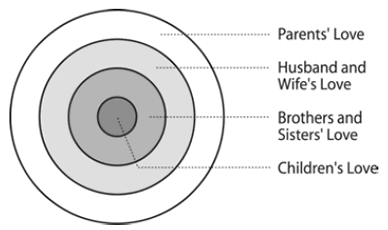
Next, the realm of parents’ love is broader than the realm of husband and wife’s love since parents are parents to their children and at the same they are husband and wife. Here must be added the fact that these four kinds of love, namely children’s love, brothers and sisters’ love, husband and wife’s love, and parents’ love, are all practiced under God’s love; therefore, all the family members can be grateful to God and, at the same time, they can regard God as their object partner of love consciously or unconsciously. The breadth of the realm of the four loves can be shown by four concentric circles as in fig. 12.1.
Husband and Wife’s Love as a Representative Love
Among the four loves mentioned above, the most representative one is the husband and wife’s love. This is because, as already mentioned, the husband represents all the men in a family and the wife represents all the women in a family; moreover, each represents one of God’s dual characteristics. Furthermore, the husband represents all men, half of humankind, and the wife represents all women, the other half of humankind; the husband represents the yang aspects of all things in the universe, and the wife represents the yin aspects of all things in the universe.
Husband and wife’s love, therefore, represents the masculine and feminine loves in a family, in all humankind, and in all things, as well as the masculine and feminine loves in God. In other words, husband and wife’s love includes all the kinds of love in the created world as well as God’s love. Thus, husband and wife’s love is the representative love in a family.
Center of the Cosmos and the Fruit of Love
I have clarified above that the husband and wife’s love is not only the love between a man and woman, but rather it is a synthesized love wherein God’s love, family love, and the love in all things are united. When such love is synthesized, there is a multiplying effect, which engenders a strong impulse which can not be repressed. The position of conjugal union represents the cosmos, namely, it is the center of the cosmos, and at the same time it is the position of the second Creator where the ideal of creation is accomplished. The True Parents of humankind (messiah) are the model, the second Creator. Thus, the position of conjugal union is very precious and holy; it is the position wherein human beings most resemble God.
The foundation for all the various types of love beyond the family-one’s love for the nation, love for humankind, love for all things, love for one’s fatherland, and so on-is conjugal love. This is because conjugal love is not only the love between a man and woman, but rather it represents all the different types of love between all subjects and objects. That is to say, conjugal love represents the love between principal element (or individual) and subordinate element (or individual) as well as the love between subject and object in the sense of Sungsang and Hyungsang.
As a matter of fact, a husband (man) represents heaven, and a wife (woman) represents the earth. In other words, the relationship between husband and wife is like that between God and the created world. Accordingly, conjugal love represents the love between God and created beings (human beings).
In principle, the husband takes the initiative and his wife acts according to his directive; therefore, the relationship between husband and wife is that of subject and object, in the sense of Sungsang and Hyungsang. Furthermore, conjugal love represents the love between spiritual beings, and physical beings in the world.
Also, in principle, the husband is the head of the family, and his wife is his support. Hence, the relationship between husband and wife is that of subject and object in the sense of superordinate and subordinate. Teacher and student, government and people, the sun and the earth, a cell nucleus and cell cytoplasm are all examples of such a relationship.
Furthermore, the husband is the representative of all men, half of humankind, and his wife is the representative of all women, the other half. Accordingly, the union of man and woman relates to the unification of humankind, and thus conjugal love is a love for all humankind. Also, the husband represents the yang aspect of the universe and spirit world, and the woman represents the yin aspect of the universe and spirit world. Hence, the conjugal union is the representative center of the cosmos.
It can be concluded that conjugal love represents all the types of love in the created world. They are all manifestations of God’s love. Therefore, husband and wife’s love, which is the representative love and synthesized love, is none other than God’s love. Hence, the position of the union of husband and wife, where such synthesized love appears, is the center of the cosmos, the position of the second Creator, and the position of the perfection of the ideal of creation.
Original conjugal love is indeed boundlessly broad and deep, and the children born through such a conjugal love are the fruit of this holy, synthesized love. Since conjugal love is the love that synthesizes God’s love and the love of the whole world, the children (new beings) who are born through that love are God’s children, who are the integration of the universe and, therefore, they are microcosms.
It is important to realize here that all phenomena take place first in the heavenly world, or the spirit world, and then manifest on the earth. Hence, the image of children being born and growing as brothers and sisters, and becoming husband and wife and then parents, namely, the phenomena that human beings are born and grow, while experiencing love step by step, take place first in heaven or, more precisely, within God’s mind. That is to say, the growth of children, growth of brothers and sisters, becoming husband and wife, and then becoming parents first takes place in an ideal form in God’s mind before they appear on earth.
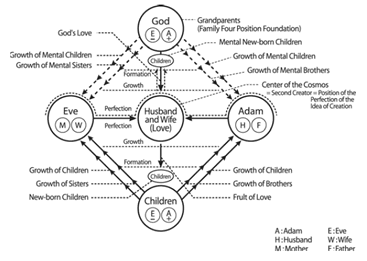
To put it another way, before creating Adam and Eve, God envisioned such a content in His mind, and then, in accordance with that vision, Adam and Eve were to be created as His children, and were to grow as brother and sister, become husband and wife, and then parents. Thus, the “envisioned” Adam and Eve, children, brother and sister, husband and wife, and parents within God’s plan can be called mental Adam and Eve, mental children, mental brother and mental sister, mental husband and wife, and mental parents respectively. This is illustrated in fig. 12.2.
A Global Realm of Heart as the Extended Form of the Four Great Realms of Heart
The four great loves are family loves, and the four great hearts are family hearts. The realm of children’s heart, the realm of brothers and sisters’ heart, the realm of husband and wife’s heart, and the realm of parents’ heart are all the realms of heart in the family. Thus, the basic form of the four great realms of heart is that of the family.
According to the Divine Principle, in the original society all human beings attend the True Parents of humankind. That is to say, in the original society all humankind becomes one great family centering on the True Parents. In other words, in the ideal world of creation, human society is a great family society existing as an extended form of a family, and each family is a miniature of the great family society, namely, it is a small family society.
Therefore, the realm of children’s heart in the family can be extended even to the global realm of children’s heart; the realm of brothers and sisters’ heart in the family can be extended even to the global realm of brothers and sisters’ heart; the realm of husband and wife’s heart in the family can be extended even to the global realm of husband and wife’s heart; and the realm of parents’ heart in the family can be extended even to the global realm of parents’ heart. Hence, the great family society of humanity is the global society of the four great realms of heart.
As already explained, the realm of heart refers to the realm of object partners of heart, or the realm of object partners of love. The global realm of the four great hearts, therefore, refers to the global realm of object partners (all humankind) of the four great loves.
Those who belong to the realm of children’s heart (children’s love) in the family are their parents, the object partners of children’s love. Then, who belongs to the global realm of children’s heart? They are adults who are about the same age as their parents: those persons all over the world whom children will respect and attend like their own father or mother.
The same thing can be said of the realm of brothers and sisters’ heart. The family realm of brothers and sisters’ heart includes brothers and sisters in a family, while the global realm of brothers and sisters’ heart includes all men and women about the same age as one’s brothers and sisters. Accordingly, wherever you may go and happen to meet men and women of about the same age as your own brothers and sisters, you can express love to them as if they were your real brothers and sisters, and you can receive love from them as well.
The same thing can not be said about the realm of husband and wife’s heart, however. The realm of husband and wife’s heart is different in character from the other realms of heart in this regard. When a woman meets a man of the same age as her husband, or when a man meets a woman of the same age as his wife, can she give him a love similar to that which she gives to her husband? Can he give her a love similar to that which he gives to his wife? Absolutely not! This is because the husband and wife relationship is a monogamous relationship incorporating a sexual life. Since husband and wife’s love is necessarily accompanied by their sexual life, conjugal love can not be allowed beyond the parameters of their relationship. Instead, one should express brothers and sisters’ love toward men or women of the same age as your husband or wife, in the same way that you love your brothers and sisters in your family.
As for the realm of parents’ heart, the same thing can be said as regards the realms of children’s heart and brothers and sisters’ heart. Wherever you may meet children of the same age as your sons or daughters, you should relate to them with a parents’ heart or parents’ love in the same way as you do to your own children.
B. Three Great Kingships
Significance of the Three Great Kingships
In speaking of the three great kingships, one may wonder what difference exists between the three great kingships and the three great subjects. As already explained, the three great subjects in the three great subjects thought refer to the centers of the family, the school, and the workplace. The king of a country is the center of the country, and therefore, he is the subject. Then, one may think that the three great kings of the world are the three great subjects, but this is not the case.
The king in the three great kingships does not mean the king of a country as it is understood in the mundane world. The kings in the three great kingships are the centers or the heads of a family. The heads of a family are the parents, and the three great kings in the three great kingships refer to the parents of the three generations: grandparents, parents and children.
Kingship means possessing the authority of a king. In the secular sense, the king is the central figure who governs the people with kingship, or, the figure in the highest position. In contrast, in the Kingdom of Heaven, as mentioned above, the king is the center and the head of a family, namely, the parents. Thus, the parents of the family are the parents and the king and queen of the family. The king of the country is the parent and the king of the country. In an enterprise, which is an extended form of a family, the president and his or her spouse are the parents and the king and queen of the enterprise.
In a family, there is only one set of parents. Then, why is it said that there are three kings in the family? Because there are three kings: the king of the past, the king of the present, and the king of the future; namely, the parents of the past, the parents of the present, and the parents of the future. Thus, three kings in a family refer to grandparents, parents, and children. The grandparents are the king and queen of the past; the parents are the king and queen of the present; and children are the kings and queens of the future. Since the grandparents, parents, and children are all kings and queens, the authority of king is given to all of them; namely, the three great kingships. Yet, the three kingships are different from each other in character.
Characteristics of the Three Great Kingships
Grandparents belong to the past and they are the king and queen of the past. It means that they were king and queen on earth in the past. Then, what is their status now? They are still king and queen. However, they are no longer a king and queen representing the earth, but a king and queen representing the spirit world. Furthermore, they are a king and queen representing God. In other words, grandparents represent the spirit world and God. Accordingly, the four position foundation centered on God as explained in the Divine Principle is also the four position foundation centered on grandparents in the original world. Therefore, from now on, grandparents will be the center of the family four position foundation, representing God and the True Parents of humankind. Hence, the position of grandparents is that of God, which is the highest in the family and, therefore, children and grandchildren have to attend their grandparents in the most respectful manner.
Parents are the king and queen representing the present world, while grandparents are the king and queen representing the spirit world. Also, parents are the king and queen in the family. Children are the future head of the family. At present, they are princes and princesses, and in the future they will be kings and queens of the family, and of the world. Children also represent all the descendants, namely, grandchildren and great-grandchildren and so on, who are also future kings and queens.
The Reason Why the Term “Three Great Kingships” Is Necessary
One may raise the following question: Why do we need to call them kings instead of just saying grandparents, parents and children? It is because the position of king is the most noble and respectable position. The conventional concepts of grandparents, parents and children are quite different from those in the original world. Through the Divine Principle, we have learned the preciousness of the family, namely, the preciousness of grandparents, parents and children. However, there is still a great difference between those concepts as conceived by God, and those which are conceived by human beings. We express the most supreme nobility with the term king or prince. Originally, every human being was to be a noble being like a king. With the study of the Divine Principle, however, we may not yet have fully realized the true nobility of the human being.
Suppose there is a prince of a country who is hiding himself in a village in a remote mountain area and wearing shabby clothes, separated from his father, the king, due to the betrayal of his men. If the elders of the village realized the truth, they would apologize to him saying, “What has happened to Your Highness? We did not know that you are such a noble person, and we have committed a great crime. Please forgive our disloyalty.” Then, with the greatest sincerity, they would respect him and attend him, placing him in the highest position. The greatest sincerity, the highest position and the best attendance that the prince would receive all express the nobility of his position as prince. The value of a human being in God’s eyes is much like this, or even greater.
Thus, the original concepts of grandparents, parents and children are very precious, and the conventional concepts are not able to convey the same noble sense as do the original concepts. There is no better means of expression than to use the concept of king in order to express their nobility, importance and gloriousness, since the king occupies the most supreme of all positions on earth. Thus, in the original world, where humans are so precious, the nobility of grandparents, parents, and children is expressed through the concepts of the three great kingships.
Parents should not treat their children casually, even when their children are young. Rather, they should treat their children just as a king would treat his prince and princess. Once the king has decided on his son as his successor, no matter how young he may be, the king will not ignore the prince’s words. Therefore, from now, parents should not neglect their children. And children should attend their parents, regarding them as king and queen, and attend their grandparents, regarding them as honorable king and queen mother (king and queen of the spirit world).
Kingship and Its Concept
A king possesses the authority of a king, namely, kingship. The kingships of grandparents, parents, and children are together called the three great kingships. In other words, authority is given to the three great kings. From this viewpoint, we should look at the members of our family, and other families, as those who are as precious as kings and queens. Hence, a home is a royal palace.
After bequeathing his throne to his child, the king becomes the grand-father in the royal palace, and stays in the central position as the great king, representing the spirit world and God. A home is as precious as a royal palace. A family constitution therefore is the constitution of a royal palace. The family of the True Parents is its model. When the ideal world is realized, all the families of the world will resemble the True Parents’ family.
Finally, let me explain about the power of kingship. Conventional power is what makes people in the object position obey the sovereign subject, usually through fear and reverence. Secular power is enforced physically. It has the authority to make people obey the sovereign compulsorily by using police or military force. In contrast, power in the Kingdom of Heaven will be that which inspires the object to obey the subject with a grateful heart, and it will be based on God’s true love.
Power in the Kingdom of Heaven, however, also has a certain authority which gives people, as objects, a certain feeling of fear. This is the fear which arises from the intuition one possesses of the spiritual death which would accrue with one’s separation from or one’s opposition to God’s true love. Since love is the source of life, and the loss of love is connected with the loss of true life, or the death of true life, should one disregard or oppose the love of the subject figure, one’s subconsciousness would perceive its inevitable result (that is, the death of life) and feel fear. This is why one would feel fear even while feeling happiness in God’s limitless love.
There is a difference between the obedience of people to the subject (the dictator) in the Communist world and the obedience of people to the subject in the Kingdom of Heaven. The dictators in the Communist world made the people obey compulsorily, threatening them with death. In the Kingdom of Heaven, however, people will want to obey the sovereign, centered on true love. This is the precise point of difference between the two worlds.
However, both worlds are the same in that the people suffer if they do not unite with the sovereign. In the Communist world, if one does not obey the dictator, one is risking one’s life, or risking being purged at once. In contrast, in the Kingdom of Heaven, if one disobeys the subject’s order which is based on love, one feels a shrinkage or risk of one’s life, to a greater or lesser degree, at once or after a certain period of time, depending on the degree of disobedience. Thus, love is accompanied with authority.
In the Bible, there is written an expression conveying the authority of God: When Abraham was prepared to offer his only begotten son, Isaac, in order to indemnify his failure in his earlier, symbolic, offering, God said, “now I know that you fear God” (Gen. 22:12). This passage makes plain that God’s love is accompanied with a certain authority and fear. Thus, secular power is enforcement with compulsory power, while power in the Kingdom of Heaven is the power of true love which induces people to obey voluntarily. Kingship is to be exercised. The exercise of the three great kingships is that the grandparents, parents, and children demonstrate such power of love over their object partners.